Infraorbital rim implants
Adds forward projection to the bony rim below the eye, reducing under-eye hollowness and giving the lower eyelid more support.
- Type
- Surgery
- Area
- Eyes & orbits
- Lasts
- Long-lasting; the implant remains unless removed.
- Prices
- €5,724 published examples, United States
Before and after in the simulation
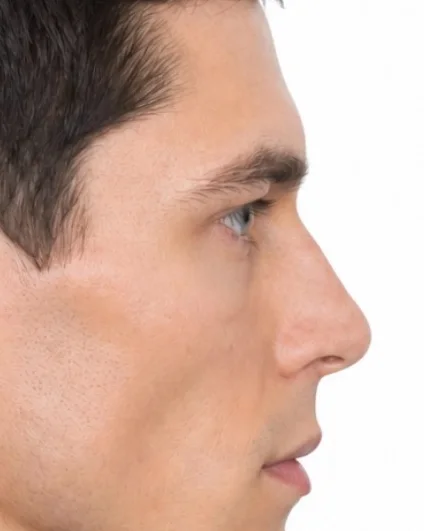 Before
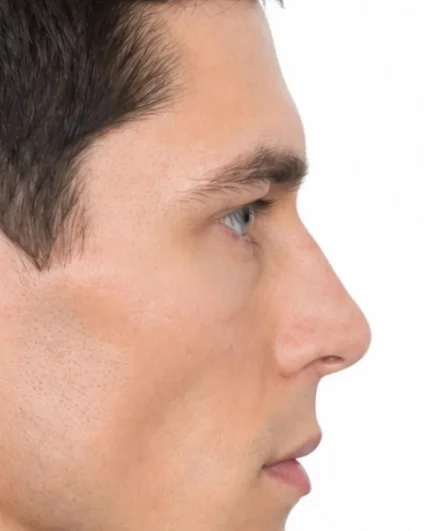 After
Made with Cephra’s own simulation on the reference face from the measurement guides, at the example strength the app starts this procedure with. Builds the bone below the eyes forward, reducing the hollow under the lower lid. It is an illustration of the shape change, not a prediction of anyone’s result.
Measurements it changes
Measured by the app on the same reference face, before and after the example above.
| Measurement | Before | After | Change |
|---|---|---|---|
| Orbital VectorSide view | -0.7 mm | 2.1 mm | +2.8 mm |
| Anterior Facial Depth AngleSide view | 70.4° | 70.8° | +0.4° |
| Measurement | Before | After | Change |
|---|---|---|---|
| Nasal Underside Rotation AngleSide view | 17.7° | 17.8° | +0.1° |
| Frankfort–Nasal Tip AngleSide view | 36.9° | 37.0° | +0.1° |
| Z AngleSide view | 72.5° | 72.6° | +0.1° |
“Move along” means the value changes because a neighbouring point or the line it is measured against moves, not because the feature itself is treated. Values belong to the reference face and the example strength; on another face, or at another strength, the same procedure moves them by other amounts. A measurement describes a photo and is neither good nor bad on its own.
What it is
An implant (silicone, porous polyethylene or custom PEEK) is placed on the bone of the lower orbital rim under the periosteum, through an incision inside the lower eyelid (transconjunctival), below the lashes (subciliary) or inside the mouth, and may be fixed with screws. It is done under general anaesthesia or sedation.
Recovery and how long it lasts
Swelling typically peaks within the first few days and resolves over about 1–3 months; temporary numbness of the cheek or upper lip usually resolves within a few months.
How long it lasts: Long-lasting; the implant remains unless removed.
Main risks
- Implant malposition or visible prominence needing revision
- Infection, sometimes requiring removal
- Numbness in the infraorbital nerve area
- Lower eyelid position change with eyelid-incision approaches
- Rare injury to the tear drainage system
The main risks named in the sources below, not a complete list. A surgeon or doctor explains the risks that apply to you.
Limits of the preview
- The example is shown in the side view; the front view has no movement for this procedure in the simulation. It moves the photo’s shape only: swelling, scars, skin quality and how tissue settles over months are not part of the picture.
Published prices
Published examples range from €5,724 to €5,724 (one provider). These are prices that providers publish themselves, not a market average and not a quote.
- Dr. Barry Eppley, Indianapolis · published cost answerUnited States · €5,724 · original 6,500 USD · checked 1 October 2026
Approximate total for combined infraorbital rim–malar implants, stated in a published patient answer, not a price table. EUR amounts are rounded to whole euros using the ECB reference rate dated 2026-09-30; payment exchange rates and fees may differ.
Research
- Custom PEEK implants for a flat midfaceFront Surg · 2026 · case series · Limited evidence
90.3% were satisfied or very satisfied at late follow-up; all had temporary swelling and 38.7% temporary lip or under-eye numbness; no infection, exposure or implant movement occurred.
- How the facial bones shrink with ageAesthetic Plast Surg · 2012 · narrative review · Limited evidence
Areas with a strong tendency to resorb are the midface (maxilla and the bone beside the nose), the upper-inner and lower-outer orbital rim, and the prejowl part of the lower jaw (mandible).
- Implants on the lower eye-socket rim to support the lower lid and cheekPlast Reconstr Surg · 2009 · case series · Limited evidence
4 patients (5%) needed revision for implant position or visibility, and 3 (3%) needed removal for infection, with two later re-implanted. The author reported improved lower-lid and cheek appearance.
Sources
- EyeWiki (American Academy of Ophthalmology) – Infraorbital Rim/Tear Trough Implants
- Periorbital skeletal augmentation to improve blepharoplasty and midfacial results (Plast Reconstr Surg 2009, abstract)
- Integrated PEEK patient-specific implants for multi-subunit midface concavity: a retrospective case series (PMC)
Patient information checked 1 October 2026. Figures vary between people and sources. This page is general information, not medical advice.
Measure your face – freeMeasured in your browser; your photos stay on your device. The simulation that shows a procedure on your own photo is part of the paid plans.