Bimax
It repositions both jaws to change the bite and the balance of the midface, lips, lower face and profile.
Jaw surgery, usually planned with braces to correct the bite; rarely done for appearance alone.
- Type
- Surgery
- Area
- Upper jaw
- Lasts
- Permanent bony change; small shifts of the jaw position (relapse) can occur
- Prices
- €6,909–€16,484 published examples, Vietnam, Japan
Before and after in the simulation
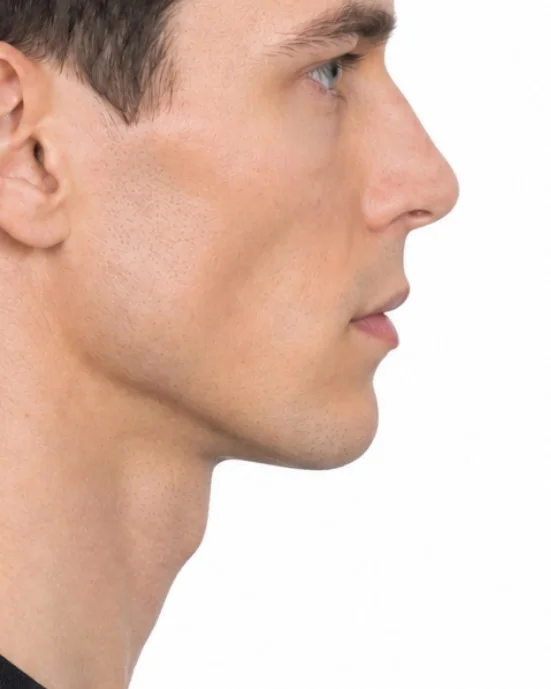 Before
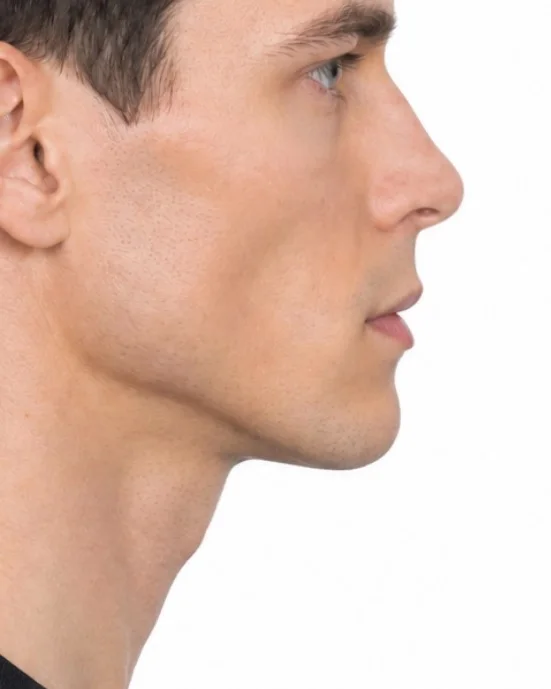 After
Made with Cephra’s own simulation on the reference face from the measurement guides, at the example strength the app starts this procedure with. Moves upper and lower jaw forward together (LeFort I + BSSO), so lips, chin and jawline come forward with them. Raising, lowering or rotating the jaws is available on the individual sliders. It is an illustration of the shape change, not a prediction of anyone’s result.
Measurements it changes
Measured by the app on the same reference face, before and after the example above.
| Measurement | Before | After | Change |
|---|---|---|---|
| Mentolabial AngleSide view | 137.4° | 143.8° | +6.4° |
| Chin Position Relative to Nasion VerticalSide view | -1.5 mm | 4.5 mm | +6.0 mm |
| Submental–Cervical AngleSide view | 109.2° | 114.9° | +5.7° |
| Frankfort–Nasal Tip AngleSide view | 36.9° | 42.2° | +5.3° |
| Z AngleSide view | 72.5° | 76.2° | +3.7° |
| Ramus-to-Mandible Length RatioSide view | 0.614 | 0.579 | -0.035 |
| Upper Lip InclinationSide view | -1.0° | 2.4° | +3.4° |
| Nasal Underside Rotation AngleSide view | 17.7° | 21.0° | +3.3° |
| Total Facial ConvexitySide view | 140.5° | 143.2° | +2.7° |
| Mentolabial DepthSide view | 18.9 % | 16.2 % | -2.7 % |
| Anterior Facial Depth AngleSide view | 70.4° | 67.8° | -2.6° |
| Interior Midface Projection AngleSide view | 67.6° | 65.3° | -2.3° |
| Measurement | Before | After | Change |
|---|---|---|---|
| Nasal Tip AngleSide view | 135.6° | 137.4° | +1.8° |
| Nasofrontal AngleSide view | 135.9° | 135.1° | -0.8° |
| Upper Lip E-Line Distance / Nasal LengthSide view | -0.086 | -0.079 | +0.007 |
| Lower Lip E-Line Distance / Nasal LengthSide view | -0.038 | -0.044 | -0.006 |
| Nasal Dorsal CurvatureSide view | -3.3 % | -3.9 % | -0.6 % |
17 smaller changes are not listed. “Move along” means the value changes because a neighbouring point or the line it is measured against moves, not because the feature itself is treated. Values belong to the reference face and the example strength; on another face, or at another strength, the same procedure moves them by other amounts. A measurement describes a photo and is neither good nor bad on its own.
What it is
The upper jaw (LeFort I osteotomy) and the lower jaw (bilateral sagittal split osteotomy) are cut, moved into a planned position and fixed with small titanium plates and screws in one operation. The work is done through incisions inside the mouth under general anaesthesia, usually combined with orthodontic treatment before and after surgery.
Recovery and how long it lasts
Usually 1–2 nights in hospital; swelling peaks at 2–3 days and mostly settles within 2–4 weeks, with subtle swelling for several months; most people take about 3–4 weeks off work or school, and the jaws take up to about a year to heal completely.
How long it lasts: Permanent bony change; small shifts of the jaw position (relapse) can occur.
Main risks
- Numbness of the lower lip and chin (common at first and usually improving over months; lasting numbness is reported at widely varying rates)
- Numbness of the upper lip, cheeks, gums or palate (usually temporary)
- Changes to the nose, such as a wider base or upturned tip, and a blocked nose early on
- Shift of the jaw or bite back toward its old position (relapse), occasionally needing further surgery
- Infection of plates or screws needing their removal; rarely serious bleeding
The main risks named in the sources below, not a complete list. A surgeon or doctor explains the risks that apply to you.
Limits of the preview
- Visible in the side view only.
- The example is shown in the side view; the front view has no movement for this procedure in the simulation. It moves the photo’s shape only: swelling, scars, skin quality and how tissue settles over months are not part of the picture.
Published prices
Published examples range from €6,909 to €16,484 (2 published examples). These are prices that providers publish themselves, not a market average and not a quote.
- Gangwhoo Cosmetic Hospital · published pricesVietnam · €6,909 · original 7,920 USD · checked 22 September 2026
Combined Le Fort I upper jaw and BSSO lower jaw. Regular published procedure price, not the separately advertised promotional price. The price line does not establish inclusion of anesthesia, hospital stay, orthodontics, travel or other fees; confirm a full quote. EUR amounts are rounded to whole euros using the ECB reference rate dated 2026-09-22; payment exchange rates and fees may differ.
- KAI Clinic Tokyo · published pricesJapan · €16,484 · original 2,970,000 JPY · checked 22 September 2026
Bimaxillary osteotomy (two-jaw surgery). Published procedure fee. General anesthesia and examinations appear as separate price-list items and are not assumed included. Orthodontics, travel and final inclusions require a separate quote. EUR amounts are rounded to whole euros using the ECB reference rate dated 2026-09-22; payment exchange rates and fees may differ.
Research
- Double-jaw advancement for sleep apnoea: results and side effectsOtolaryngol Head Neck Surg · 2025 · meta-analysis · Strong evidence
Breathing-event index fell by about 42 events per hour; early lower-face numbness occurred in 83%, persisted in 67% before 1 year and 33% after 1 year, and 22% had plates or screws removed. No major complications or deaths were reported.
- Braces alone versus jaw surgery for borderline underbiteClin Oral Investig · 2022 · systematic review · Strong evidence
Surgery brought the upper jaw forward and the lower jaw back and rotated the lower jaw plane; camouflage tilted upper front teeth forward and lower front teeth back more.
- How accurately computer planning predicts the final jaw positionHead Face Med · 2020 · systematic review · Strong evidence
Average position differences were under 2 mm for both upper and lower jaw, with rotational differences under about 2.75°; differences under 2 mm or 2° were usually considered acceptable, and virtual planning seemed better for side-to-side symmetry.
- How common body dysmorphic disorder is in cosmetic and other settingsBody Image · 2016 · meta-analysis · Strong evidence
Estimated prevalence was 1.9% in adults in the community, 13.2% in general cosmetic surgery, 20.1% in rhinoplasty patients, 11.2% in jaw (orthognathic) surgery patients and 5.2% in orthodontic or cosmetic dentistry settings. Women outnumbered men in most but not cosmetic settings.
- Numbness and recovery after jaw surgery in 579 casesCureus · 2026 · cohort study · Moderate evidence
Cheek-area numbness occurred in 16.0% after Le Fort I and lower-lip numbness in 31.6 to 39.3% of sides after lower-jaw splits; recovery at 6 months was 94.4% and 92.9%; advancing the lower jaw 5 mm or more raised the risk.
17 studies in the research library are linked to this procedure; the strongest are shown.
Sources
- Cambridge University Hospitals NHS – Jaw or chin corrective surgery: patient information and consent
- Cleveland Clinic – Jaw Surgery (Orthognathic)
- Narita et al. 2026, Cureus – Neurosensory disturbances after orthognathic surgery (579 cases), PMC
Patient information checked 1 October 2026. Figures vary between people and sources. This page is general information, not medical advice.
Measure your face – freeMeasured in your browser; your photos stay on your device. The simulation that shows a procedure on your own photo is part of the paid plans.